The distinction between life coaching and counseling is often blurred in popular discourse. Both involve structured conversations, both aim to improve people’s lives, and both rely heavily on interpersonal skill. But beneath that surface similarity are two fundamentally different models: one grounded in personal development, the other in clinical mental health care.
Understanding where that line sits is not just academic—it directly affects outcomes, safety, and appropriateness of care.
-
Counseling is a regulated mental health service that focuses on assessing, diagnosing, and treating emotional and psychological conditions. It uses evidence-based therapeutic approaches to address distress, improve functioning, and support long-term mental health.
-
Life coaching is a non-clinical, goal-focused process that helps individuals improve performance, clarify direction, and build effective habits. It emphasizes future outcomes, accountability, and actionable strategies, and is best suited for people seeking growth rather than treatment of mental health conditions.
The Core Difference: Optimization vs. Treatment
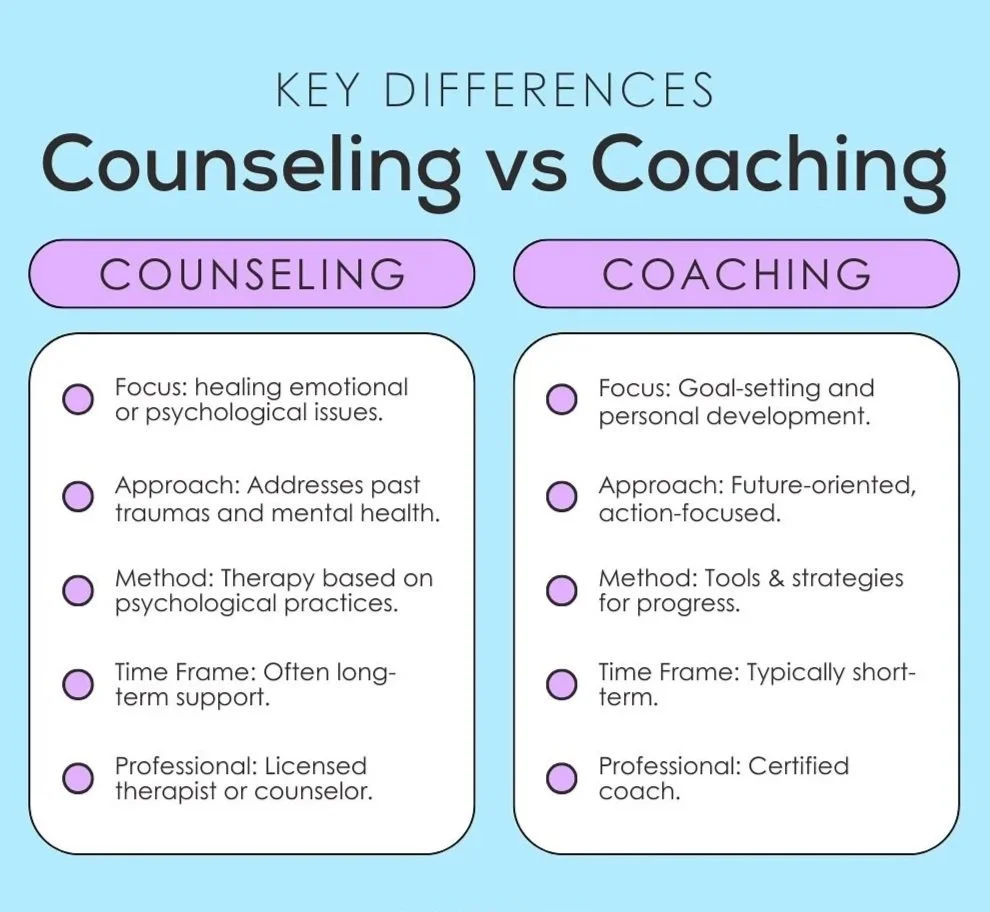
At the highest level, life coaching and LPC counseling diverge in purpose.
Life coaching is built around optimization. The client is assumed to be fundamentally functional but seeking improvement—more clarity, better habits, stronger execution. The work is forward-facing and pragmatic, often centered on questions like: What do you want, and how do we get you there efficiently?
LPC counseling, by contrast, operates within a treatment model. The focus is not just on where the client is going, but on what may be interfering with their ability to function in the first place. That includes identifiable mental health conditions, but also subclinical patterns—chronic anxiety, unresolved grief, maladaptive coping—that require more than goal-setting to address.
This difference in purpose shapes everything else.
Training, Regulation, and Scope
The gap between coaching and counseling becomes more concrete when looking at training and oversight.
A Licensed Professional Counselor has completed graduate-level education, supervised clinical hours, and licensing exams. They are regulated by a state board, held to enforceable ethical standards, and required to maintain continuing education. Their scope includes diagnosis, treatment planning, and clinical intervention.
Life coaching has no universal regulatory structure. While there are reputable certification programs, they are not legally required, and standards vary widely. As a result, coaching operates in a more flexible but less controlled environment.
This is not just a credentialing difference—it defines what each professional is allowed to do. An LPC can diagnose and treat mental illness. A coach cannot, regardless of experience or intent.
How the Work Actually Feels in Practice
From the client’s perspective, sessions can sometimes feel superficially similar. Both involve conversation, reflection, and some degree of structured change. The divergence becomes clearer in how problems are approached.
Coaching tends to stay at the level of strategy and execution. If a client is procrastinating, the focus might be on time management systems, accountability, or reframing motivation. The assumption is that the barrier is behavioral and can be addressed directly.
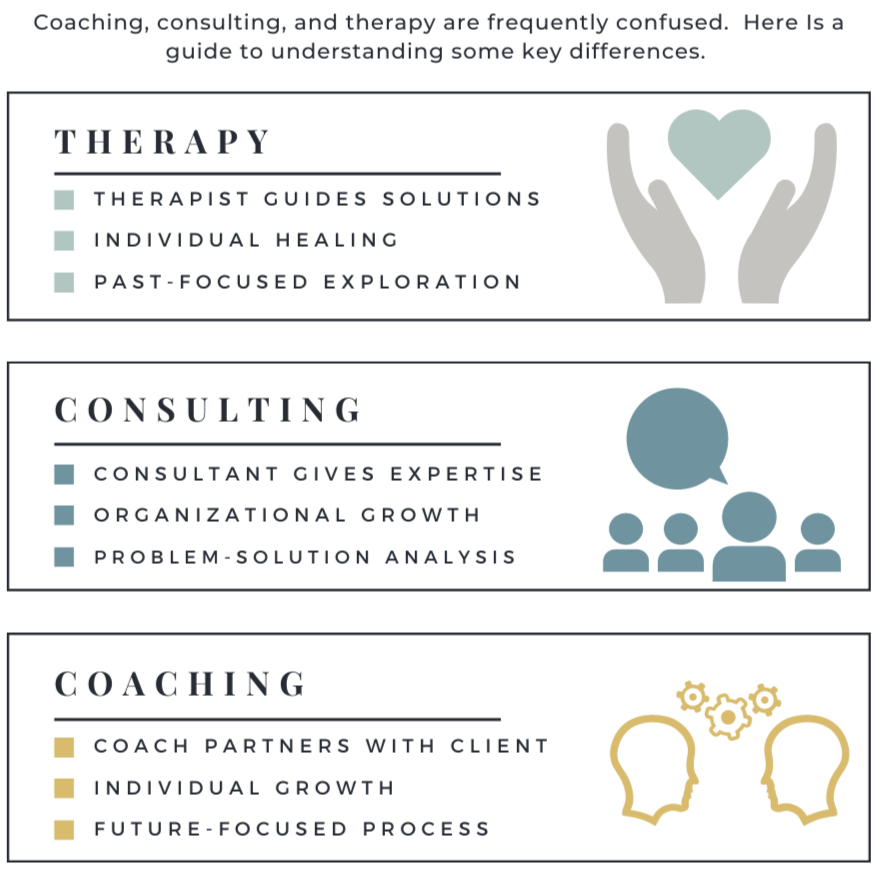
Therapy, particularly within LPC practice, is more likely to ask why that pattern exists. Procrastination might be explored in the context of anxiety, perfectionism, or underlying beliefs about failure. The intervention may involve cognitive restructuring, emotional processing, or gradual exposure—approaches rooted in psychological theory.
In other words, coaching asks, “How do we fix this?”
Therapy also asks, “What is this, and where did it come from?”
The Role of Distress and Mental Health
Another dividing line is how each field engages with distress.
Coaching generally assumes a baseline of psychological stability. Distress may be present, but it is framed as a barrier to performance rather than a condition requiring treatment. The work is not designed to manage clinical risk.
LPC counseling is explicitly structured around distress. Whether mild or severe, emotional suffering is treated as clinically relevant. Therapists are trained to assess risk, recognize diagnostic patterns, and intervene appropriately—including in high-stakes situations like suicidality or trauma.
This has ethical implications. When distress crosses a certain threshold, continuing in a coaching framework is not just ineffective—it can be inappropriate.
Time Orientation and Depth
Life coaching is predominantly future-oriented. The past may come up, but usually only insofar as it informs present action. The emphasis remains on movement and outcomes.
Therapy is more temporally flexible. It often involves moving between past, present, and future to understand patterns. For some clients, especially those with longstanding issues, meaningful change requires examining earlier experiences and how they continue to shape perception and behavior.
This is less about “dwelling on the past” and more about identifying mechanisms that are still active.
Where the Overlap Exists—and Where It Stops
There is a genuine overlap in interpersonal skill. Both coaches and therapists use active listening, reflective questioning, and structured dialogue. Both can help clients clarify priorities and make changes.
However, the overlap is at the level of technique, not responsibility.
The critical difference is that therapists are accountable for recognizing when an issue is clinical—and for treating it appropriately. Coaches are not trained or authorized to operate at that level, even if the surface conversation looks similar.
Choosing Between Them
The decision is less about preference and more about fit to problem type.
If someone is generally functioning well but feels directionless, unmotivated, or stuck in execution, coaching can be effective. It provides structure without entering a medicalized framework.
If someone is experiencing persistent distress, emotional dysregulation, or patterns that feel difficult to control, therapy is the more appropriate setting. These issues often require clinical assessment and evidence-based intervention.
In some cases, both can be useful—but only when their roles are clearly separated. Therapy addresses underlying stability; coaching builds on that foundation.
Final Perspective
Life coaching and LPC counseling are not competing professions—they serve different functions. One is designed for enhancing performance, the other for addressing mental health and psychological functioning.
Confusion arises when these roles are treated as interchangeable. They are not. The distinction ultimately comes down to this:
Coaching assumes the system is intact and aims to improve output
Therapy evaluates whether the system itself needs repair
Using the correct framework is not just a matter of preference—it determines whether the intervention is appropriate to the problem at hand.
At Dymphna Counseling, we provide professional mental health support and counseling services for individuals, couples, and families in McAllen, Texas, and surrounding areas. Our practice specializes in evidence-based therapy for anxiety, depression, trauma, and other emotional challenges.
We also offer guidance for personal growth and life optimization, helping clients set and achieve meaningful goals. Whether you are seeking therapy or structured coaching, Dymphna Counseling in McAllen is here to support your mental health and well-being.
Visit DymphnaCounseling.com to schedule a consultation or learn more about our services.
